
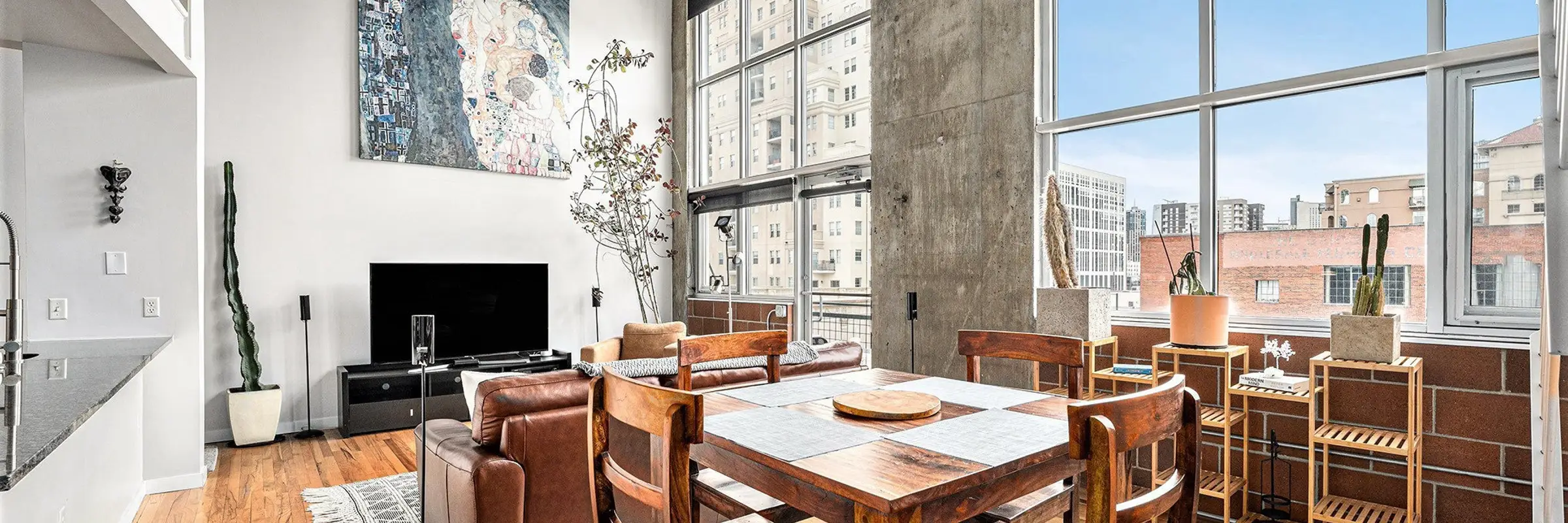
Downtown Denver Real Estate: A Guide
Downtown Denver real estate is among the most sought-after in the state of Colorado. Not only is it in the commercial hub of the Rocky Mountain West, but its incredible neighborhoods like LoDO and Union Station are some of the best areas to live in Denver. RINO, and even the bordering Highlands, house some of the best-performing properties on the market
In this guide, we look at the central, Downtown Denver neighborhoods most investors consider, and what you should consider before buying, selling, or renting in Downtown Denver. Let’s break it all down below.
Is Downtown Denver real estate a good investment in 2026?
Although downtown Denver can still provide a reasonable ROI in 2026, potential investors will need to be very discerning in their purchases, especially on price. This is no longer a market where you can buy almost any property and count on rising values to carry the investment.
According to Redfin’s May 2026 data, the median sale price of real estate in Downtown Denver is $590,000. Compared to this time last year, that’s a 0.5% increase. It took a median of 33 days for homes to sell in May, down from 39 days in May 2025. The median sale price per square foot is down 7.5%, and houses are selling at an average of 2% off their listed prices. Zillow’s June 2026 data for ZIP code 80202 shows a softer picture. Zillow’s typical home value was $553,139, down 3.9% over the previous year. Zillow also reported that its rent index for the ZIP code declined by 1.8%.
For investors, this creates an interesting market. Prices have stayed flat, and sellers have lost much of their leverage, creating what some will term a “buyer’s market.” A buyer who finds a property that has been sitting on the market may have room to negotiate the purchase price or ask for concessions.
Redfin and Zillow work differently, but they do tell a similar story. And that story is one of flat or declining prices.
| Downtown Denver indicator | Latest figure | What it means for investors |
|---|---|---|
| Median sale price | Approximately $590,000 | Prices remain substantial, but annual growth was nearly flat. |
| Median price per square foot | $450 | Down 7.5% year over year, creating room to compare value between buildings. |
| Median days on market | 33 days | Buyers have more time for building and HOA due diligence. |
| Sale-to-list ratio | 98.2% | The average property sold below its asking price. |
| Typical 80202 home value | $553,139 | Zillow estimated a 3.9% annual decline as of June 2026. |
| 80202 rent index | $2,051 per month | Rents were down 1.8% year over year, pointing to stronger tenant competition. |
Downtown Denver is not one real estate market.
Many people use the title “Downtown Denver” to refer to an area larger than the City of Denver’s formal definition of downtown.
LoDo (Lower Downtown) and RiNo (River North) are well-known district names in Denver but don’t align well with Denver’s officially defined Statistical Neighborhoods. RINO runs through portions of Five Points, for example, which technically isn’t considered part of Downtown Denver.
For this guide, Downtown Denver includes the six districts buyers most often compare when searching for centrally located investment property.
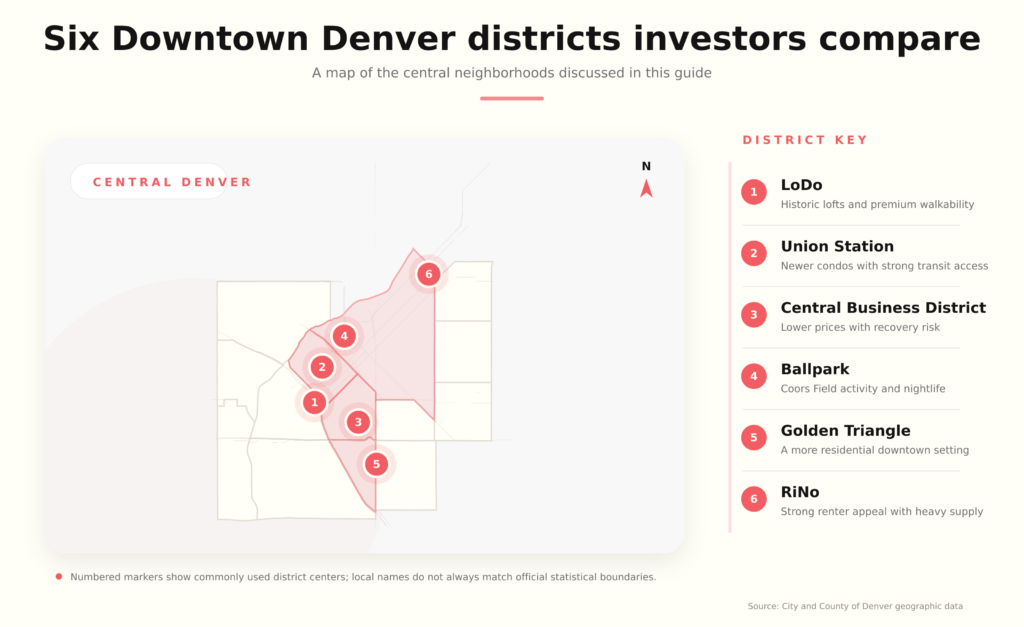
| Area | Common property types | Relative entry cost | Strongest rental angle | Main risk |
|---|---|---|---|---|
| LoDo | Historic lofts and converted warehouse condos | High | Premium long-term or furnished stays | Older buildings and nightlife noise |
| Union Station | Newer luxury condos and high-rise units | High | Professionals and furnished mid-term renters | High HOA costs and apartment competition |
| Central Business District | Older condo towers and mixed-use buildings | Lower to moderate | Value-focused long-term rentals | Uneven office and street-level recovery |
| Ballpark | Lofts, condos and newer apartment-style units | Moderate | Renters who value events and nightlife | Noise and major differences by block |
| Golden Triangle | Condo towers, townhomes and newer infill | Moderate to high | Long-term and furnished mid-term stays | Construction activity and building expenses |
| RiNo | New condos, apartments and industrial conversions | Moderate to high | Lifestyle-driven renters and furnished stays | Large pipeline of competing rental units |
LoDo: historic properties in a premium location
LoDo appeals to renters for its unique blend of historic warehouse lofts, excellent walkability, and proximity to many of Denver’s most popular attractions. Historic features, such as exposed brick walls, make each property stand out from traditional apartment living. Historically old buildings may also require an investor to reserve additional funds for items such as elevator maintenance/repair, roof replacement/maintenance, and/or masonry repair. LoDo is ideal for investors who desire to purchase a historically rich property, have adequate reserves, and target professional renters who prefer the downtown area and/or are looking for a short-, medium-, or long-term furnished rental opportunity.
Union Station: convenience with a higher price tag
Union Station offers newer housing, airport rail access, and a strong residential environment. Zillow placed its typical home value at approximately $616,000 in June 2026, compared with roughly $393,000 in the Central Business District. Investors must also account for substantial HOA fees in buildings with shared amenities or structured parking. The area may suit executive renters and relocating professionals, but the higher entry price makes careful underwriting essential.
Central Business District: lower prices with recovery risk
The Central Business District offers lower entry prices than LoDo or Union Station, but its performance remains tied to the office market. The Downtown Denver Partnership reported a 28.8% office vacancy rate during the first quarter of 2026. Conditions can vary sharply by block, so the CBD is best suited to patient investors who can buy below comparable prices and hold through continued redevelopment.
Ballpark: activity near Coors Field
Renters are often attracted to the Ballpark neighborhood for its warehouse-style buildings, proximity to Coors Field, nightlife, and central location. However, that same location can also mean more noise, particularly at night when nearby bars, restaurants, and events are busy.
The neighborhood’s feel can change significantly within just a few blocks. Before purchasing a property, it is worth visiting the immediate area at different times of the day and night to get a better sense of what renters will experience.
Ballpark can be a strong option for short-term and longer-term furnished rentals, particularly if the property includes parking. It may be less appealing to renters looking for a quieter, more residential atmosphere.
Golden Triangle: a more residential downtown option
The Golden Triangle residential community is situated near Civic Center Park, the Denver Art Museum, and Denver Health. It combines old condominium high-rises with new projects that may attract couples, remote employees, and mid-term renters. Older condominiums offer much larger floor plans than many newly constructed downtown apartment communities. This means you will need to evaluate the development pipeline in the Golden Triangle carefully. New development could improve the neighborhood and make it more attractive to renters, but it could also add significant inventory and increase competition between properties.
RiNo: strong renter appeal with heavy new supply
Creative entrepreneurs and young professionals are drawn to RiNo for its abundance of unique nightlife, bars, and restaurants, proximity to the RTD A Line at 38th and Blake, and a variety of trendy retail stores. The area has become increasingly competitive for renters due to the sheer number of new-construction apartments built over the past decade. Because it is situated within Five Points, overall neighborhood statistics will serve as a general indicator for trends affecting both areas.
Median sales prices on Redfin.com indicate that in May 2026, the median was approximately $588,000. The average time for which properties remained on the market was about 43 days. As such, investors should focus on securing or purchasing units with distinguishing features that set them apart from other local multi-family properties.
Which rental strategy works in Downtown Denver?
Because of Denver’s short-term rental regulations, renting for 30+ days is the suggested rental strategy for Denver. That being said, different situations call for different strategies.
| Rental strategy | Potential advantage | Main limitation | Best fit |
|---|---|---|---|
| Long-term rental | More predictable occupancy and simpler operations | Strong competition from downtown apartment buildings | Owners seeking stable tenancy |
| Furnished mid-term rental | Higher monthly rates may be possible | Utilities, furnishing and turnover reduce the added revenue | Properties near employment, transit or medical facilities |
| Short-term rental | Flexible use for an owner-occupant | The property must qualify as the host’s primary residence | Residents who occasionally host while away |
| Owner-occupied hybrid | Combines personal use with rental income | Requires active compliance with city and HOA rules | Buyers who plan to live in the property |
Do not underwrite a downtown condo as an Airbnb before checking the rules
Confirm the city license path and read the HOA declaration before making an offer. A listing description that says “short-term rental potential” does not establish legal eligibility.
A Downtown Denver condo investment example
Consider a two-bedroom condo purchased for $600,000. The unit has a $750 monthly HOA fee.
The long-term model assumes rent of $3,000 per month. The furnished model assumes $4,200 per month with 10% vacancy. These figures are illustrations, not market forecasts.
| Annual item | Long-term rental | Furnished 30+ day rental |
|---|---|---|
| Scheduled rental revenue | $36,000 | $50,400 |
| Vacancy allowance | ($1,800) | ($5,040) |
| HOA fees | ($9,000) | ($9,000) |
| Property tax estimate | ($3,600) | ($3,600) |
| Insurance | ($1,500) | ($1,800) |
| Utilities and internet | Paid by tenant | ($3,600) |
| Maintenance allowance | ($1,800) | ($2,400) |
| Furniture reserve | — | ($1,500) |
| Management allowance | ($2,880) | ($7,560) |
| Estimated net operating income | $15,420 | $15,900 |
| Estimated cap rate | 2.6% | 2.7% |
The overall strategy generated an additional $14,400 in rental income under the rent schedule. Net income from the two strategies, after deducting all operating expenses and vacancies, is $480.
Investors should compare net operating income, not just rent, to evaluate different investment opportunities. The numbers provided do not include financing costs, closing costs, or income taxes, and they do not include potential special assessments. Taxes and fees charged by the property manager will vary depending upon the property.
Why HOA due diligence matters downtown
Most Downtown Denver investment opportunities are condos. That makes the HOA almost as important as the unit itself.
Before buying, review:
- Monthly dues and what they cover
- Rental minimums and rental caps
- Any waiting period before a unit can be leased
- The current reserve study
- Planned special assessments
- Building insurance and recent claims
- Pending litigation
- Owner delinquency levels
- Parking ownership and monthly fees
- Move-in charges
- Rules for furnished rentals
- Recent board meeting minutes
What could increase Downtown Denver investment demand?
Downtown Denver investment demand could strengthen as the area becomes more residential. In 2025, foot traffic reached 90% of pre-pandemic levels, with 73 million visits. The area added 72 ground-floor businesses, while residential occupancy remained at 88%. Another 468 homes were completed, and more than 1,600 were under construction. Seven potential office conversions could add 1,200 homes while removing about 1.3 million square feet of office space. This shift may support local businesses and evening activity, although the added housing will create more competition for landlords.
The main risks of investing downtown
Downtown properties carry risks that are less common in suburban rentals.
- HOA dues can consume a large share of rent.
- Special assessments can quickly change the investment return.
- New apartments may offer concessions that individual landlords cannot match.
- Nightlife and event noise affect tenant demand.
- Older buildings can require expensive shared repairs.
- Office recovery remains uneven.
- Some condo buildings are harder to finance.
- Short-term rental rules limit nightly rental strategies.
These risks don’t mean Downtown Denver is a risky investment; far from it. They are just things to consider before investing in a property.
Who should invest in Downtown Denver real estate?
For those with both patience and cash reserves. Downtown Denver is a stable bet. If you need cash flow right away, however, it might not be the best option.
Best for patient buyers with sufficient reserves.
- Buyers who can hold through a slower market.
- Investors with enough cash reserves for HOA changes.
- Owner-occupants who want to offset part of their housing costs.
- Landlords targeting professionals or relocating tenants.
- Buyers who find a distinctive unit with limited direct competition.
- Investors who value long-term neighborhood redevelopment.
Higher risk for buyers who need quick or dependable returns.
- Buyers who need strong immediate cash flow.
- Investors relying on non-owner-occupied Airbnb income.
- Owners with limited reserves.
- Buyers who have not reviewed the HOA.
- Investors depending on quick appreciation.
Is Downtown Denver the right market for you?
Downtown Denver is the commercial hub of the Rocky Mountain West, and anytime its prices aren’t rising, consider entering, as it’s probably a deal.
FAQ
Are Downtown Denver condos a good investment?
Yes. If you buy a downtown condo that supports your anticipated income with the purchase price and HOA costs, then a condo investment could work well. That being said, every condo is different, and it’s important to do your own DD.
Which part of Downtown Denver is best for rental property?
Union Station and LoDo are likely to attract renters who want convenience and are willing to pay for it. The Golden Triangle area will probably feel more like a home for residents. The central business district may offer investors lower entry points, and RiNo may appeal to younger renters who enjoy new amenities and nightlife.
Can investors operate an Airbnb in Downtown Denver?
Denver only licenses short-term rentals at the operator’s primary residence. HOAs may impose additional restrictions. A standard non-owner-occupied condo generally cannot operate as a legal short-term rental under the city’s residential license.