

1031 Exchange Colorado: What Are The Rules?
A Colorado investor can use a 1031 exchange to avoid paying taxes on qualified gains from selling qualified investment or business property in Colorado, as long as that property is exchanged for another qualified property. In an ordinary delayed 1031 exchange Colorado, you have a 45-day window to select the new property for the 1031 Exchange, followed by a 180-day deadline to close on the selected property. Whichever comes first is your tax filing due date with all extensions applied.
Those deadlines just scratch the surface on the entire process, and below we’ll walk you through the rest.
For rental owners, another question deserves equal attention: will the replacement property work as a rental? A successful exchange should support your investment goals after the closing paperwork is complete.
How does a 1031 exchange work?
Section 1031 of the Internal Revenue Code permits you to transfer the value of a qualifying investment in real estate that you have owned and used as part of your trade or business from one piece of real estate to another while delaying the recognition of a taxable gain. The property that you give up is referred to as the “relinquished property,” and the property that you receive is referred to as the “replacement property.”
A typical delayed exchange involves using a qualified intermediary, who will help you set up and manage this transaction, including receiving and holding the proceeds of the sale of the relinquished property. You sell the relinquished property before acquiring the replacement property.
The primary advantage of using section 1031 is delaying taxes on gains realized when you sell a piece of real estate. Those gains are usually carried over to the replacement property by adding them to the replacement property’s tax cost basis, which may affect how much tax you pay when you sell it again. If you spend more than what you received for the relinquished property for the replacement property, it does not increase your cost basis in the replacement property.
This leaves more money available to invest in your next project. Compare the terms of the financing, operating expenses, and expected net operating income of both properties before making a decision about whether an exchange makes sense with respect to your overall investment strategy.
What properties qualify for a 1031 exchange?
Both properties must be real estate held for investment or productive use in a trade or business. “Like-kind” is broader than it sounds: the properties do not need the same layout, condition, or rental model.
Held for investment or business use.
- Rental homes and apartment buildings held for investment.
- Commercial real estate held for business or investment use.
- Land held for investment.
Check the property’s use and asset type.
- A home used solely as a personal residence.
- Property held primarily for resale, such as a house purchased to flip.
- Freestanding furniture and other personal property.
What are the 45-day and 180-day deadlines?
Both periods run from the transfer of the relinquished property. They run at the same time; the 180-day period does not start after the first 45 days.
45 days to identify
Identify replacement property in a signed written document and deliver it to a permitted recipient, usually your qualified intermediary, by midnight on day 45.
Up to 180 days to acquire
Receive the identified replacement property by the earlier of day 180 or the due date of your tax return for the transfer year, including extensions.
Make sure to use a clear physical (street) address or a legal description in the identification of your home. A list of potential homes on your phone or a conversation with an agent is not enough to satisfy this written notice requirement.
If you are selling your home at year-end and your income tax return is due before the end of Day 180 after closing, it may be helpful to speak with your CPA as soon as possible about obtaining a filing extension so you have enough time to complete the 180-day replacement property exchange period. Although a filing extension will give you more time to file your tax return, it will not extend the 180-day replacement property rule.
How many replacement properties can you identify?
The regulations offer alternative identification rules. Your QI should confirm which rule fits your plan before you submit the notice.
| Identification rule | What it allows |
|---|---|
| Three-property rule | Identify up to three properties, regardless of their combined fair market value. |
| 200% rule | Identify any number of properties if their combined fair market value does not exceed twice the combined fair market value of the relinquished properties. |
| 95% exception | If you exceed both limits above, qualifying under this exception generally requires acquiring at least 95% of the total value of all identified properties. |
For the 200% rule, relinquished property values are determined upon termination of the exchange period. Relinquished property values will be determined as of the date of the actual transfer of relinquished property. The 95% exception has its own valuation rules and provides very little opportunity for failed exchanges.
Why should you arrange a qualified intermediary before closing?
An exchange must have an established exchange structure prior to closing the subject sale. If you receive proceeds from a sale ,whether directly or indirectly, or gain unrestricted access to such proceeds, then the sales transaction is considered a taxable event. The fact that you send such proceeds to a qualified intermediary subsequent to receiving the proceeds does not retroactively make the initial receipt non-taxable.
A aualified intermediary assists in structuring the exchange agreement, assigning contract rights, and facilitating the flow of funds. A qualified intermediary may not be a substitute for your regular advisor; related parties and specified agents of the taxpayer are excluded from participating.
Before your sale closes
- Arrange your QI. Confirm that the intermediary is eligible to serve in that role before the property transfers.
- Complete the exchange documents. Coordinate the agreement and any contract assignments with your QI and closing agent.
- Confirm the funds route. Arrange for exchange proceeds to move through the exchange structure without passing through your personal account.
- Review ownership and title. Have your tax adviser check any proposed changes involving an LLC, partnership, spouse, or other owner.
What protections does Colorado require?
Colorado regulates covered exchange facilitators under C.R.S. § 6-1-721. The law provides alternative ways to protect exchange funds. These include specified bond and insurance coverage, qualifying deposits or letters of credit, or a qualified escrow or trust arrangement with joint written withdrawal authorization.
It also requires covered facilitators to safeguard client assets.
Ask your exchange facilitator
- Where will the exchange funds be held?
- Who can authorize withdrawals?
- Which financial protections cover the funds?
- How does the written agreement document those protections?
How much do you need to reinvest?
For a straightforward exchange, investors looking to defer their tax liability typically buy replacement property equal to or greater than what they relinquished and reinvest all net proceeds from the transaction. In addition to determining the fair market value of both properties, the investor will need to calculate the amount of “debt,” “exchange fees,” and “non-qualified” property involved.
Boot is another term for cash or other like-kind property an investor receives during an exchange. Boot may result in taxable income; however, it will be capped at the amount of gain recognized.
You don’t have to obtain a new mortgage for exactly the same amount as your original mortgage. Cash from a down payment can offset some of the debt relief. On the other hand, taking out a larger loan for a replacement property will not eliminate all the cash you retain.
A Colorado rental exchange example
Suppose an investor sells a qualifying rental for $900,000. Its adjusted tax basis is $400,000, and the mortgage payoff is $300,000. That leaves $600,000 of exchange equity and $500,000 of realized gain.
The examples below assume an otherwise valid exchange. They exclude transaction costs, personal property, and special depreciation recapture issues to keep the comparison clear.
| Item | Full deferral example | Partial deferral example |
|---|---|---|
| Replacement purchase price | $1,000,000 | $950,000 |
| Exchange equity reinvested | $600,000 | $550,000 |
| New loan | $400,000 | $400,000 |
| Cash returned to investor | $0 | $50,000 |
| Gain recognized currently | $0 | $50,000 |
| Gain deferred | $500,000 | $450,000 |
| Replacement tax basis | $500,000 | $500,000 |
Also, $50,000 of recognized gain is not a $50,000 tax bill. The actual tax depends on the investor’s circumstances and the character of the gain. A CPA should calculate both the current tax and the replacement basis.
How does Colorado tax affect the exchange?
Colorado individual income tax is based on federal taxable income plus applicable state adjustments to that federal taxable income. That means an otherwise deferred gain from a sale, which would be excluded as long as it was done under Section 1031, will stay out of the starting point for determining Colorado taxable income.
State tax laws depend on several factors, including whether you reside in Colorado or another state; your business’s ownership structure and how each party participates in your business; and the nature of the specific property items included in your tax returns and subject to state adjustments.
Check nonresident withholding before closing
Certain foreign sellers of Colorado property are subject to withholding upon the close of escrow. Under DR 1083, the State of Colorado will waive withholding for transactions of $100,000.00 or less.
When withholding does apply, the amount withheld would generally be the smaller of two percent (2%) of the sales price or the net proceeds which are otherwise payable to the seller.
Can a Colorado vacation rental qualify?
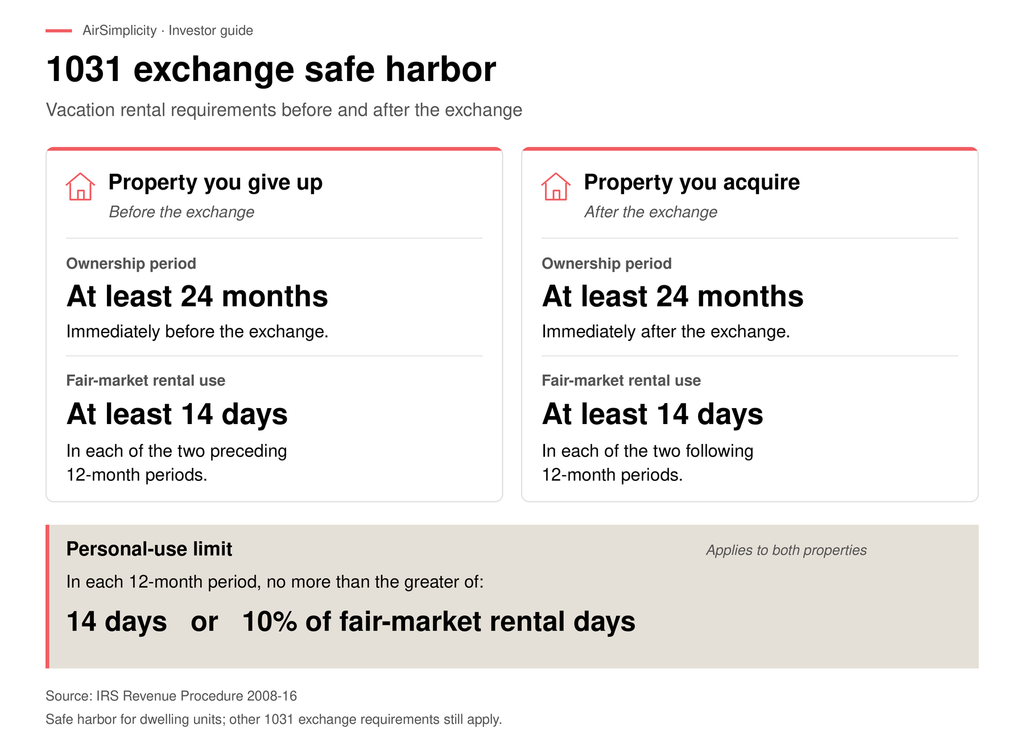
A vacation rental qualifies as an eligible dwelling unit if you use it to support a business or investment. The intent to stay personally, to rent out, and how you intend to use your home at the end of the vacation exchange will be relevant. Simply listing your home for rent does not, by itself, prove you rented it for business or investment use.
The IRS created a Safe Harbor Rule in Revenue Procedure 2008-16, which states the IRS “will not challenge” whether your dwelling unit meets the requirements for either business or investment purposes, provided you meet the other criteria in this procedure. The Safe Harbor is specifically for determining compliance with the Use Requirement.
| Safe harbor requirement | Property you give up | Property you acquire |
|---|---|---|
| Ownership period | At least 24 months immediately before the exchange. | At least 24 months immediately after the exchange. |
| Fair-market rental use | At least 14 days in each of the two preceding 12-month periods. | At least 14 days in each of the two following 12-month periods. |
| Personal-use limit | In each 12-month period, no more than the greater of 14 days or 10% of fair-market rental days. | In each 12-month period, no more than the greater of 14 days or 10% of fair-market rental days. |
For example, 200 days of fair-market rentals allows up to 20 personal-use days in the relevant 12-month period under this test.
Keep records that show how the property was used:
- Booking history: Dates and lengths of paid rental stays.
- Rental records: Payments received and evidence supporting fair-market rates.
- Personal-use calendar: Dates when the property was used for personal stays.
These are exchange-related 12-month periods, not necessarily calendar years. Also, the 24-month rule is part of this specific safe harbor. It is not a universal minimum holding period for every 1031 exchange. A property outside the safe harbor needs a separate assessment of its facts. Rev Proc 2008-16.doc
Confirm that local rules allow your rental plan
Federal exchange eligibility and local permission to operate a rental are separate questions.
For example, Denver requires a standard short-term rental to be the host’s primary residence. A non-primary-residence property cannot obtain that standard license. Denver identifies a separate lodging-facility licensing route, but zoning and building requirements limit where it is available.
Therefore, an investor should not buy a Denver home on the assumption that a 1031 exchange permits full-time vacation rental use. Check the specific property’s jurisdiction, zoning, licensing requirements, and HOA restrictions before committing to that income model. City and County of Denver
How should you evaluate a replacement rental?
Start with the rental use the property can legally support. Then build an operating budget around that use.
Start with what local rules allow.
Check the property’s zoning and licensing requirements, along with any HOA restrictions. Build your income forecast around the rental use that the property can legally support.
Plan beyond the best booking month.
Compare expected revenue with taxes, insurance, utilities, repairs, management, and HOA fees. Allow for vacancy and slower seasons, with a reserve for major replacements.
Account for the cash needed to open.
Budget for furnishings and any work needed before the first booking. Ask your tax team which costs belong in the exchange and which need separate funding.
Decide how the property will run.
Decide who will handle pricing and day-to-day guest needs, including turnover coordination. Explore AirSimplicity’s vacation rental management services as you compare operating options.
Finally, decide who will manage the home. AirSimplicity’s vacation rental management services cover areas such as pricing, guest communication, and turnover coordination. Include those operating needs when comparing properties. AirSimplicity
Evaluate your next Colorado rental
Explore the property’s rental potential and management needs with AirSimplicity as you plan your next investment.
Request a free property evaluationPlan the exchange around a property that works
Understanding the 1031 exchange rules in Colorado helps you protect the intended tax treatment. Choosing a suitable replacement helps protect the investment itself. Bring the tax adviser and QI into the process early, then review rental feasibility before the deadlines begin to drive your decisions.
AirSimplicity offers a free property evaluation with a revenue projection and insight into rental earning potential. Use that operating perspective alongside the exchange guidance from your CPA or tax attorney.